
Skin Boosters Compared: RRS HA Long Lasting vs Neauvia Hydro Deluxe vs Filorga NCTF 135 HA
Laser hair removal is a popular method of removing unwanted body hair. It has become even more common in the last few years.
The evolution of aesthetic medicine has shifted decisively away from mere mechanical filling towards the biological curation of the cutaneous substrate. While high-elasticity cross-linked dermal fillers remain irreplaceable for supraperiosteal projection and profound structural deficits, they cannot rectify the biological exhaustion of an aged extracellular matrix (ECM). For aesthetic practitioners and discerning patients alike, the therapeutic objective has expanded: the modern goal is not simply to project tissue, but to orchestrate physiological skin rejuvenation.
True skin conditioning requires an intervention that alters cellular behaviour. Injectable skin boosters have consequently evolved from basic intradermal hydrators into complex biochemical instruments capable of genuine bio-remodelling. Navigating this pharmacodynamic space demands a rigorous appreciation of molecular design. Three market-leading formulations illustrate this biological diversity: RRS HA Long Lasting, Neauvia Hydro Deluxe, and Fillmed NCTF 135 HA. While each sits within the skin conditioning category, their biochemical compositions, clinical techniques, and regenerative pathways diverge significantly.
| Feature | RRS HA Long Lasting | Neauvia Hydro Deluxe | Fillmed NCTF 135 HA |
|---|---|---|---|
| Primary Architecture | BDDE cross-linked HA | Un-cross-linked pure HA | Un-cross-linked free HA |
| Key Active Additive | Protective Amino Acid Buffer (Cluster) | 0.01% Calcium Hydroxyapatite | 50+ Polyrevitalising Complex |
| Primary Tissue Plane | Deep dermis to subdermal junction | Mid-to-deep dermis | Superficial papillary dermis |
| Core Clinical Target | Bio-remodelling & persistent tension | Mechanical redensification | Cellular bio-revitalisation |
| Treatment Frequency | 1–2 sessions per year | 3 sessions at 3-week gaps | 3–5 sessions over 3 months |
Biochemical Blueprints: Molecular Formulations and Modes of Action
The clinical performance of any injectable booster is dictated by its molecular scaffold, cross-linking chemistry, and secondary bioactive compounds.
RRS HA Long Lasting
Cross-linked HA + Amino Acid Buffer
Occupies an intermediate space between a classic mesotherapy cocktail and a monophasic dermal filler. Its chassis relies on cross-linked sodium hyaluronate synthesised via 1,4-butanediol diglycidyl ether (BDDE) technology.
Suspended in an amino acid buffer that acts as an osmoprotective shield, mitigating shear-induced free radical degradation and downregulating post-injection inflammatory cascades.
Neauvia Hydro Deluxe
Ultrapure HA + 0.01% CaHA Micro-particles
Formulated using hyaluronic acid derived from non-pathogenic Bacillus subtilis, yielding an un-cross-linked polymer matrix of high purity, low endotoxins, and free of residual bacterial proteins.
Contains 0.01% Calcium Hydroxyapatite (CaHA) with glycine and L-proline. Micro-spheres exert physical stretch on fibroblasts, initiating mechanotransduction pathways that drive type I/III collagen and elastin synthesis.
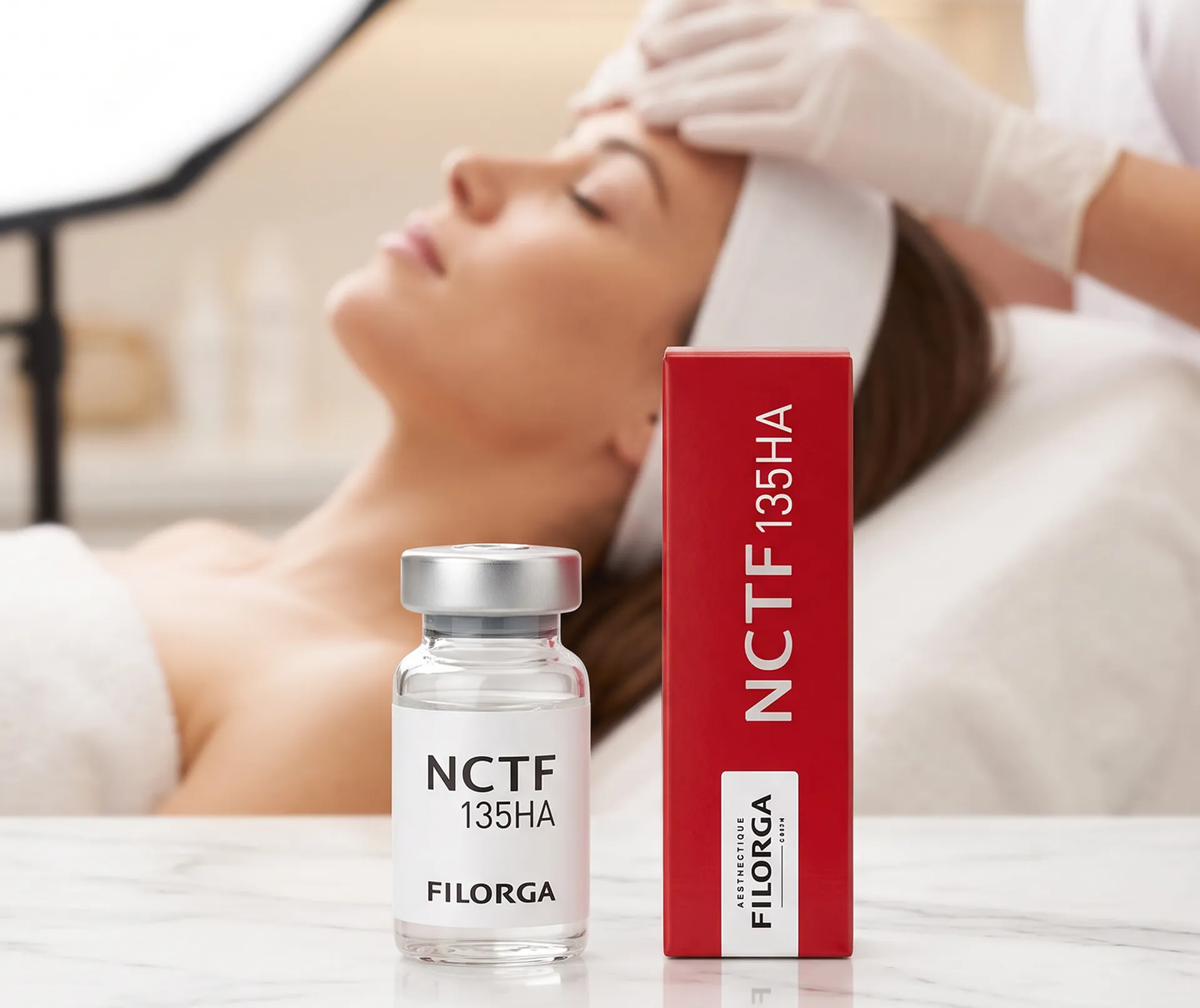
Fillmed NCTF 135 HA
Free HA + 50+ Polyrevitalising Complex
Functions directly at the level of cellular metabolism. The non-cross-linked vehicle facilitates rapid interstitial diffusion to deliver an elaborate complex of physiological micro-nutrients.
- 12 essential and non-essential vitamins
- 24 amino acids for peptide assembly
- 6 minerals and 6 coenzymes
- 5 nucleic acid bases
- Glutathione and reducing agents
Precision Delivery: Planes, Geometries, and Protocols
The biochemical diversity of these three formulations mandates distinct clinical placement strategies. Mismatches between molecular weight and injection plane risk visible cutaneous irregularities, post-procedure oedema, or therapeutic failure.
Because it contains free, non-cross-linked HA, NCTF 135 HA must be delivered into the superficial papillary dermis using a classic micro-papular technique with 30G to 32G needles, or microneedling arrays such as the Fillmed Nanosoft (0.6 mm) system.
The resulting blanched papules resolve within 24 to 48 hours as the product assimilates into local tissue, making it suitable for delicate zones including the infraorbital rim, perioral rhytids, and the neck.
Neauvia Hydro Deluxe targets the mid-to-deep reticular dermis. Placement too superficially risks persistent white papules caused by the non-resorbable nature of CaHA micro-spheres during their primary settling phase.
Delivery is commonly achieved via serial micro-boluses (0.02 to 0.05 ml per point) or retrograde linear threading using a 30G needle or a 25G/27G cannula. It provides structural redensification for thin, crepey areas, including the lateral cheeks, submental region, décolletage, and dorsal hands.
RRS HA Long Lasting functions as a bio-remodelling agent requiring placement strictly at the deep dermal to subdermal junction. Superficial placement risks causing visible, long-lasting nodules due to its cross-linked composition.
Administered using a bio-aesthetic vector approach: delivering 0.1 to 0.2 ml micro-boluses across seven targeted anatomical tension points per hemiface, or utilising a 25G cannula for retrograde linear fanning along vectors of skin laxity.
Tissue Kinetics: Longevity, Enzymatic Clearance, and Clinical Payoff
A product's clinical longevity depends directly on its enzymatic resilience, clearance pathways, and physical properties.
Relative Longevity Profile
- RRS HA Long Lasting: Exhibits high resistance to enzymatic breakdown due to covalent BDDE cross-links. The surrounding amino acid cluster shields the macromolecular web from oxidative stress, offering an immediate dermal splinting effect followed by extended bio-remodelling.
- Neauvia Hydro Deluxe: The un-cross-linked HA vehicle is progressively cleaved over several weeks, yet the 0.01% CaHA micro-particles persist within interstitial spaces for months. These micro-particles act as physical catalysts for neocollagenesis, leading to progressive tissue thickening and restored elasticity.
- Fillmed NCTF 135 HA: Cleared by native hyaluronidases within 48 to 72 hours. Its clinical value lies in the biological metabolic cascade it initiates: saturating the microenvironment with amino acids, minerals, and vitamins to jump-start cellular respiration and fibroblast output.
Strategic Patient Stratification
Achieving consistent clinical results requires matching the patient's individual histopathology with the appropriate biochemical profile.
Cellular Starvation
Prescription: Fillmed NCTF 135 HA
Profile: Younger patients with early photo-ageing, devitalised smoker skin, or delicate periorbital crinkling and dehydration lines.
Logic: Demands micronutrient restoration rather than deep mechanical lift, avoiding risks of lymphatic congestion or Tyndall effects in fragile zones.
Dermal Thinning
Prescription: Neauvia Hydro Deluxe
Profile: Patients displaying loss of dermal thickness, sleep-creases on the cleavage, neck crinkling, or dorsal hand elastosis.
Logic: CaHA micro-particles trigger mechanoreceptors to initiate neocollagenesis where basic hydration cannot compensate for collagen depletion.
Deep Dehydration
Prescription: RRS HA Long Lasting
Profile: Mature patients with cutaneous deflation, deep micro-relief lines, and severe dehydration seeking low-maintenance schedules.
Logic: Provides a single-session intervention that exerts mild horizontal skin tension across vectors of laxity, stabilising the ECM over several months.
Synergistic Treatment Paradigms
Skin boosters rarely function in isolation within advanced clinical practices. They are most effective when integrated into multimodal aesthetic programmes designed to address aging tissue across every anatomical layer.
The Multi-Layered Structural Model
- Layer 1: Deep Bone / Supraperiosteal High-G' Dermal Fillers (Structural Projection)
- Layer 2: Subdermal / Deep Dermis RRS HA Long Lasting (Vectorial Scaffolding)
- Layer 3: Mid-to-Deep Reticular Dermis Neauvia Hydro Deluxe (Collagen Inducing)
- Layer 4: Superficial Papillary Dermis Fillmed NCTF 135 HA (Micronutrient Radiance)
- Layer 5: Cutaneous Dynamics & Tone Combined Neuromodulators & Energy Devices
Neuromodulator Co-Administration
While intramuscular botulinum toxin relaxes dynamic expression lines, micro-papular delivery of NCTF 135 HA simultaneously improves passive micro-rhytids etched into overlying tissue. Direct intradermal micro-doses of toxin mixed with un-cross-linked boosters can concurrently target pore dilation, superficial dynamic crinkling, and local erythema.
Energy-Based Device Integration
Administering NCTF 135 HA immediately following fractional lasers or radiofrequency microneedling leverages micro-thermal channels to drive active cofactors into injured tissue, accelerating re-epithelialisation. Pre-treating tissue with Neauvia Hydro Deluxe or RRS HA Long Lasting 2 to 4 weeks prior hydrates the matrix for a more predictable thermal response.
Using high-G' fillers to treat fine superficial rhytids risks unnatural, over-volumised contours. Precision rejuvenation relies on restoring underlying structural deficits first, followed by dedicated biological conditioners targeted to each distinct cutaneous plane.