
Profhilo: What It Is and How It Differs From Other Boosters
Laser hair removal is a popular method of removing unwanted body hair. It has become even more common in the last few years.
The Science of Bio-Remodelling: Understanding Profhilo
To understand Profhilo, one must first dismantle the misconception that all hyaluronic acid (HA) injectables behave identically. Dermal fillers rely on synthetic chemical cross-linking agents—most commonly 1,4-butanediol diglycidyl ether (BDDE)—to bind hyaluronic acid molecules into a viscous, cohesive gel capable of resisting enzymatic breakdown and projecting physical tissue volume.
Profhilo abandons chemical cross-linking altogether. Instead, it is formulated using patented thermal production technology that fuses high-molecular-weight HA and low-molecular-weight HA into stable, hybrid cooperative complexes. This unique process yields one of the highest concentrations of pure hyaluronic acid on the medical market (64 mg per 2 ml syringe) without a single trace of BDDE or chemical additives.
NAHYCO® Thermal Hybridisation
Because of this unique chemical architecture, Profhilo exhibits exceptionally low dynamic viscosity and high fluid spreadability. Once introduced into the skin, it does not form a static, localized implant. Instead, it flows effortlessly through the interstitial spaces of the deep dermis and subcutaneous tissues, bathing the local microenvironment in unadulterated hydration.
This fluid diffusion initiates what aesthetic medicine terms bio-remodelling. Profhilo does not simply trap moisture in the superficial epidermis; its sustained, slow-release delivery mechanism stimulates the body’s own cellular machinery. Over several weeks, it actively upregulates the synthesis of four distinct variants of collagen (types I, III, IV, and VII) alongside elastin fibres within dermal fibroblasts and keratinocytes.
The physiological result is genuine structural rejuvenation: enhanced epidermal firmness, improved dermal elasticity, and restored tissue integrity from within.
The Booster Spectrum: How Traditional Skin Boosters Work
To appreciate the distinct nature of bio-remodelling, we must examine the broader family of classic skin boosters. Traditional injectables in this category are designed to deliver targeted, superficial hydration and nutritional replenishment directly to the upper-to-mid dermis, bypassing the compromised barrier function of the epidermis.
Micro-Cross-Linked Hyaluronic Acids
Products such as Restylane Skinboosters use lightly cross-linked HA micro-droplets. These tiny reservoirs sit quietly in the dermal plane for months, attracting water molecules to plump fine dehydration lines and create a long-lasting reservoir of deep moisture.
Uncross-Linked HA & Mesotherapy Cocktails
Treatments such as Seventy Hyal, Teoxane Redensity 1, and NCTF 135HA blend free hyaluronic acid with extensive complexes of essential amino acids, minerals, vitamins, and antioxidants to stimulate local metabolic processes.
The primary clinical objective of traditional skin boosters is concentrated, direct biological nourishment. By depositing minute micro-papules of active ingredients across targeted zones, they boost cellular metabolism, improve surface luminosity, and soften micro-crepiness. They excel at refining epidermal texture, restoring vitality to sun-damaged or devitalised skin, and creating an unmistakable, lit-from-within dewy glow.
Fundamental Differences: Profhilo Versus Traditional Boosters
While both therapeutic approaches leverage hyaluronic acid to combat the structural signs of ageing, their engineering, anatomical placement, and ultimate clinical outcomes differ fundamentally.
| Clinical Parameter | Profhilo (Bio-Remodelling) | Traditional Skin Boosters / Mesotherapy |
|---|---|---|
| Primary Indication | Dermal laxity, tissue thinning, and global crepiness | Superficial dehydration, dullness, fine lines, and irregular texture |
| Chemical Composition | Thermally bonded hybrid complexes of pure HA (BDDE-free) | Lightly cross-linked HA or non-cross-linked HA combined with micronutrients |
| Tissue Interaction | Rapid interstitial diffusion across tissue planes; multi-collagen and elastin synthesis | Localised placement; water retention and direct micro-nourishment of the upper dermis |
| Delivery Technique | Bio Aesthetic Points (BAP)—typically 5 anatomical points per side of the face | Comprehensive micro-injection grid technique (dozens of direct micro-droplets) |
| Lifting & Tightening | Measurable improvement in structural dermal tensile strength and gentle tissue tightening | Superficial plumping and smoothing; no structural tightening effect |
Delivery Mechanics: Diffusion Versus Deposition
One of the most striking practical distinctions lies in their administration. Traditional skin boosters demand an intensive micro-injection grid. A clinician meticulously introduces dozens—sometimes upwards of fifty—tiny blebs of product across the treatment zone to blanket the area evenly.
In contrast, Profhilo relies on its exceptional tissue-diffusion capacity via the Bio Aesthetic Points (BAP) technique. Developed through rigorous anatomical studies, the BAP protocol specifies just five designated injection sites per side of the lower and mid-face:
The 5 Anatomical BAP Sites (Per Side)
These sites are chosen specifically because they avoid major neurovascular pathways while maximising the product's natural migration through lymphatic and anatomical fascial planes. From these ten discreet entry points, Profhilo glides across the entire anatomical region, minimising patient discomfort, reducing the risk of vascular compromise, and dramatically lowering injection-site bruising.
The Emerging Regenerative Picture: Where Polynucleotides Fit
It is also worth distinguishing hyaluronic acid formulations from regenerative innovations like polynucleotides (PN). While Profhilo acts as a hydrating architectural matrix that triggers collagen production via biomechanical stimulation, polynucleotides are purified DNA fractions derived from salmon or trout gametes.
Polynucleotides function primarily as bio-stimulatory signalling molecules rather than volumising or hydrating reservoirs. They bind directly to cell surface receptors, kickstarting deep tissue repair, blunting chronic inflammation, promoting microvascular angiogenesis, and actively healing compromised extracellular matrices.
Clinicians frequently deploy polynucleotides where hyaluronic acid might draw unwanted water weight—such as the fragile, lymphatic-compromised infraorbital hollows—making them an invaluable partner to, rather than a replacement for, HA-based bio-remodelling.
Setting Clear Boundaries: What Profhilo Cannot Do
Much of the confusion surrounding Profhilo stems from well-intentioned but loose marketing language. Patients occasionally arrive at clinics expecting the transformative profile sculpting of a dermal filler, or the muscle-relaxing smoothness of botulinum toxin.
Profhilo targets skin quality, elasticity, and density. It treats the canvas itself, not the underlying architectural frame or the muscles that move it.
The Treatment Journey, Safety, and Longevity
The standard clinical protocol for Profhilo involves an initial loading phase of two treatment sessions spaced four weeks apart. In cases of advanced elastosis or mature skin, a third session may be introduced four weeks later. Results unfold subtly and progressively.
Following the procedure, small, raised blebs resembling bee stings will remain visible at the injection sites. Because Profhilo spreads spontaneously, these localized deposits typically flatten and dissipate into the tissue within 24 to 48 hours. Downtime is remarkably minimal; patients can usually return to their normal routines with only brief modifications, such as avoiding strenuous exercise, saunas, and active topical skincare for the first day.
The safety profile of Profhilo is exceptional. Because it is completely devoid of synthetic chemical agents such as BDDE, the body metabolises the compound cleanly without lingering foreign cross-link residues, significantly lowering the risk of delayed-onset granulomas or immunological hypersensitivity reactions.
Ideal candidates present with mild-to-moderate dermal laxity, dullness, early sun damage, and crepiness on the face, neck, décolletage, or hands. Absolute contraindications include active cutaneous infections or inflammation at the injection sites, pregnancy, breastfeeding, and active autoimmune disease flares.
The Power of Synergy: Combining Profhilo With Other Modalities
Aesthetic medicine is rarely a zero-sum game. Rather than serving as an isolated monotherapy, Profhilo truly shines when integrated into a carefully curated, multifaceted treatment programme.
Comprehensive Full-Face Rejuvenation Architecture
Botulinum Toxin
Softens dynamic upper-facial lines around the glabella, forehead, and peri-orbital regions.
Profhilo
Bio-remodels dermal architecture, restores skin snap, and blankets tissues in deep hydration.
Dermal Fillers
Replenishes deep fat volume loss and provides structural bony support to cheeks and jawline.
By pairing bio-remodelling with structural cross-linked dermal fillers, an aesthetic doctor can address the multi-layered nature of facial ageing in a single, coordinated strategy. Fillers restore depleted deep fat pads and reinforce bone resorption around the temples, cheeks, and jawline, while Profhilo blankets the overlying skin, tightening laxity and restoring dermal resilience.
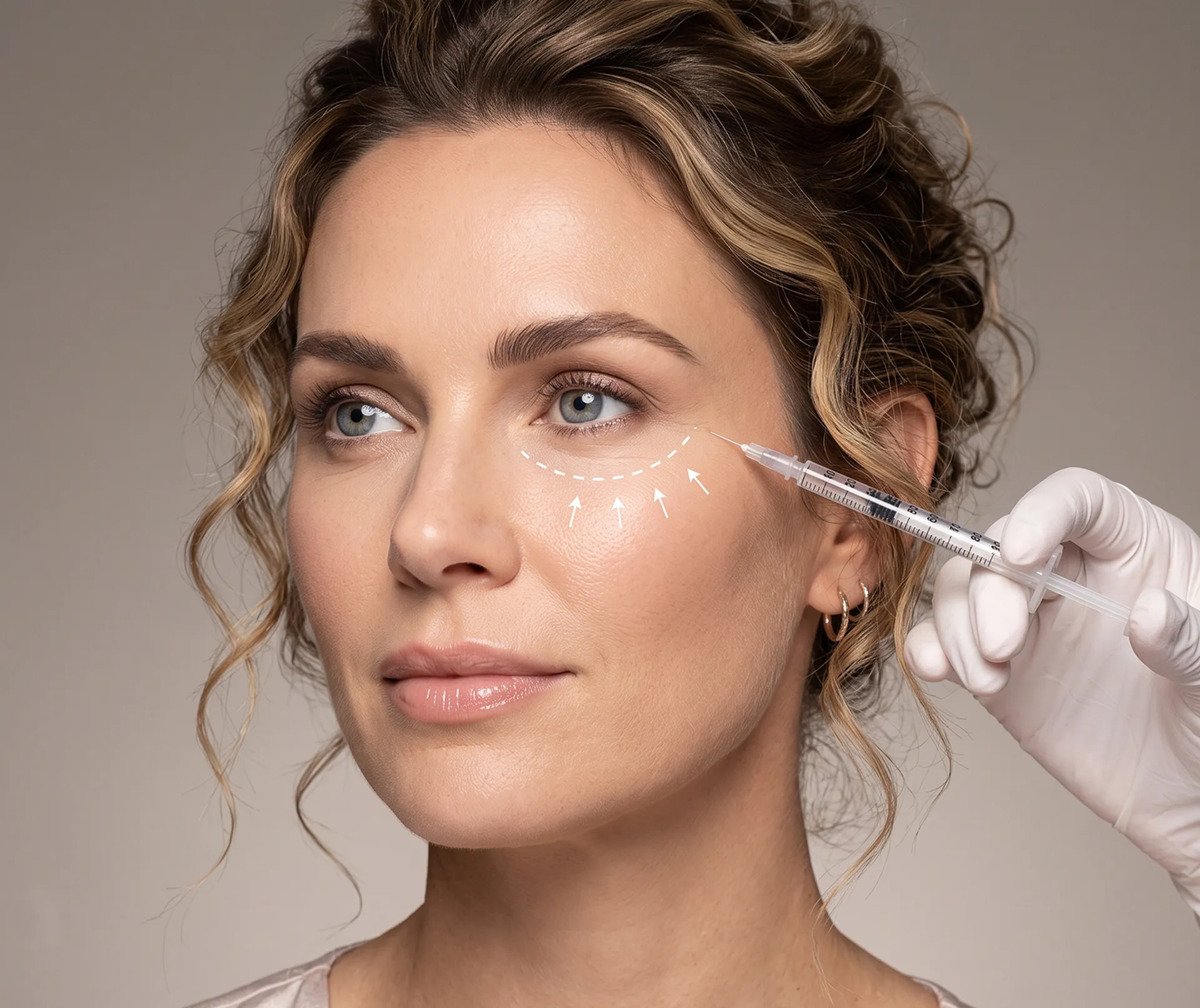
For the periorbital zone—an area unsuitable for Profhilo's wide diffusion due to delicate lymphatic drainage—clinicians frequently alternate bio-remodelling with focused polynucleotide therapies. This pairing revitalises the fragile eye contour while simultaneously tightening the surrounding mid-face tissues.
Finding the Right Approach for Your Skin
When to Choose Skin Boosters
If your primary concern is superficial dehydration, a lack of post-winter glow, or fine, crepey surface lines, an intensive course of traditional micronutrient skin boosters or mesotherapy will rapidly restore epidermal vitality and bounce.
When to Choose Profhilo
If your skin is beginning to lose its structural spring, showing early signs of jowling, tissue thinning, or crinkling laxity, Profhilo delivers the targeted bio-remodelling needed to trigger new collagen synthesis and restore deep dermal integrity.
A personalised medical consultation is always the essential first step. A thorough anatomical assessment, combined with a close review of your skin's unique cellular health, will ensure your treatment journey is safely and precisely tailored to your aesthetic goals.