
Professional Deep Pore Cleansing Techniques for Home Care
Laser hair removal is a popular method of removing unwanted body hair. It has become even more common in the last few years.
In the hallowed halls of aesthetic dermatology, few topics elicit as much fervour—and as much misinformation—as the humble pore. To the untrained eye, pores are often viewed as aesthetic adversaries: tiny craters that disrupt the smoothness of our complexion.
"Pores are not flaws; they are the essential ventilation and delivery systems of the skin’s biological landscape."
The Science of Pore Congestion
What we colloquially call a "pore" is the opening of a pilosebaceous unit—a follicle containing a hair and a sebaceous (oil) gland. These openings are genetically determined in size, and their primary function is to allow sebum to reach the surface, maintaining the integrity of the skin barrier.
The Myth of "Opening and Closing"
Pores possess no muscles to facilitate movement. While steam helps soften hardened sebum (making extraction easier), the pore itself does not change size on command. Conversely, cold water merely constricts local blood vessels, offering a temporary appearance of tautness.
The Double Cleansing Ritual
In the professional realm, the "single wash" is considered inadequate for anyone wearing daily SPF or makeup. This method applies the chemical principle that "like dissolves like."
1. The Lipid Phase
Involves an oil-based cleanser. Non-comedogenic oils bind to lipophilic (oil-loving) debris—oxidised sebum, long-wear foundation, and water-resistant sunscreens—without stripping the skin.
2. The Aqueous Phase
A gentle, foaming cleanser removes remaining residue. This step ensures that subsequent active ingredients can penetrate the skin rather than sitting atop a film of pollution.
The Art of Exfoliation: Chemical Precision
The goal is to encourage cell turnover without compromising the skin barrier. For deep pore cleansing, two specific acids stand out:
-
BHAs (Salicylic Acid)Oil-soluble molecules that dive deep into the pore to dissolve the "glue" holding congestion together.
-
PHAs (Polyhydroxy Acids)Larger molecules that penetrate slowly, providing gentle exfoliation and humectant hydration for sensitive skin.
Targeted Ingredient Deep-Dive
| Ingredient | Function |
|---|---|
| Retinoids | Speeds up cellular turnover and regulates sebum production. |
| Squalane | A bio-identical lipid providing weightless hydration without clogging pores. |
| Bisabolol | A soothing agent derived from chamomile that reduces redness and irritation. |
| Kaolin Clay | Acts as a gentle vacuum for excess oil and surface impurities. |
The Professional AM/PM Routine
- Cleanse: Light wash with a gentle foaming cleanser.
- Tone: Toning foam with AHAs/PHAs for even distribution.
- Target: Vitamin C serum to prevent sebum oxidation.
- Defend: Non-comedogenic SPF 50 (Crucial for collagen support).
- Double Cleanse: Oil cleanser followed by a purifying wash.
- Treatment: Focused Salicylic Acid or Clay mask (2-3x weekly).
- Active: Prescribed Retinoid to regulate cell turnover.
- Recovery: Moisturizer with ceramides and Bisabolol.
Professional Tools for Home Use
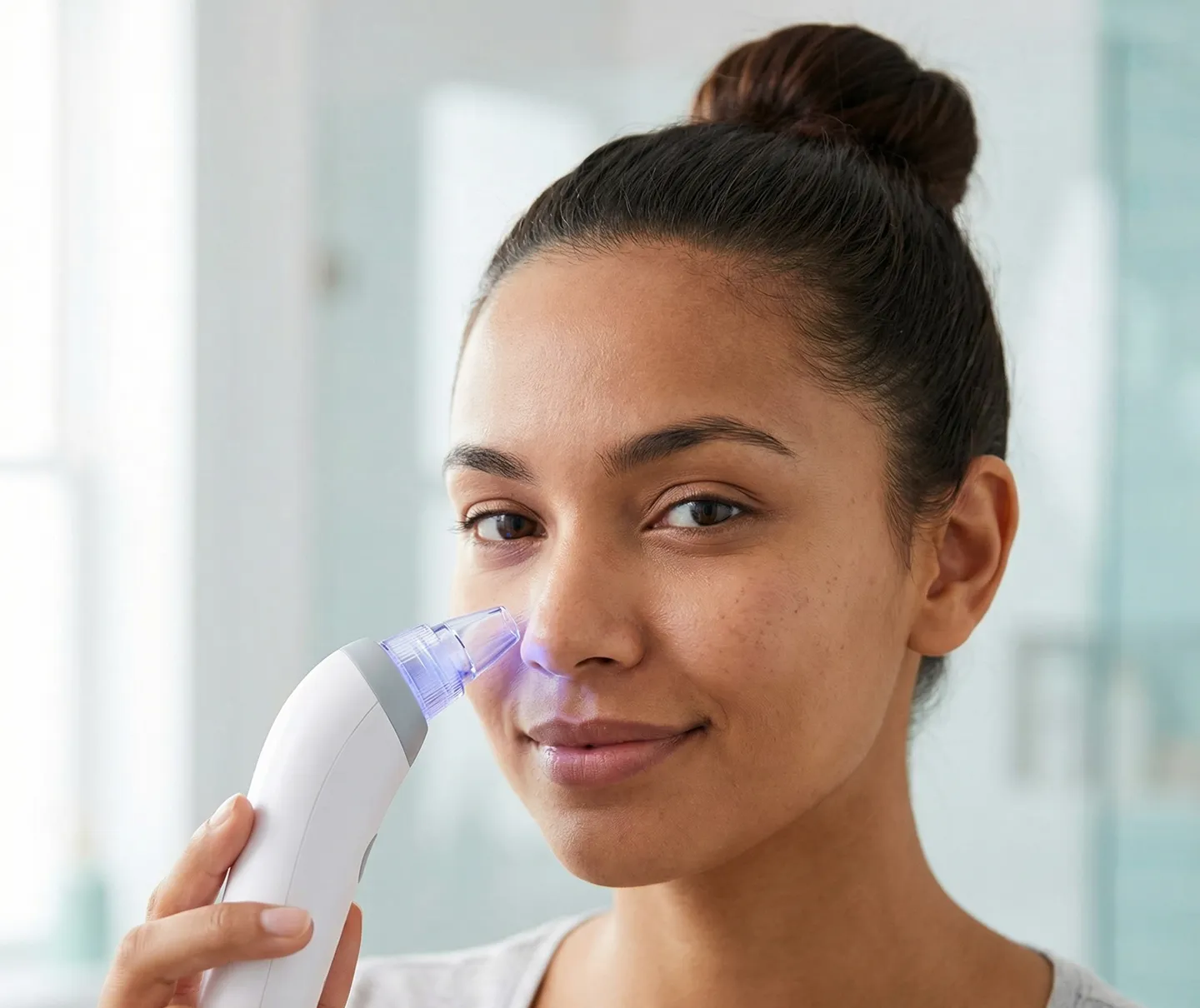
When using extraction tools or vacuums, the golden rule is "Safety First."
Pore Vacuums
Use lowest setting; keep moving to avoid bruising.
Extractors
Only target "ripe" blackheads with even pressure.
Humidifiers
Prevents skin from becoming "parched" and trapping oil.
Realistic Expectations
"Poreless" skin does not exist in nature. Healthy skin has texture, a natural sheen, and visible pores. Professional pore care is not about "erasing" these features, but about ensuring they are clear and functional.
By respecting the skin barrier and using clinically proven ingredients, you can achieve a complexion that is remarkably clear and radiant. Remember: the goal is health, not perfection.